

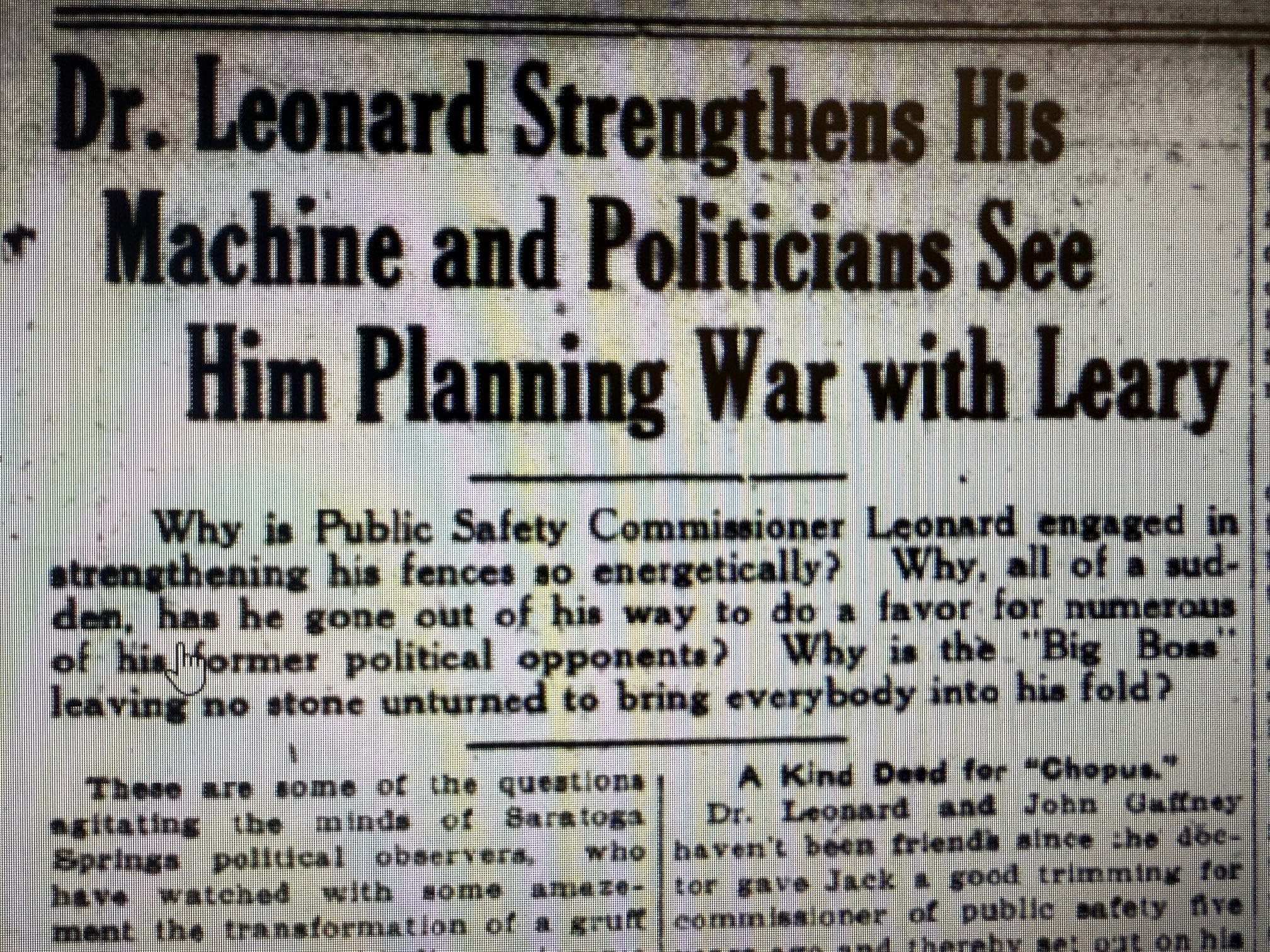
Dr. Leonard Strengthens His Machine and Politicians See Him Planning War with Leary
Why is Public Safety Commissioner Leonard engaged in strengthening his fences so energetically? Why is the 'Big Boss' leaving no stone unturned to bring everyone into his fold?

Boardwalk Empire has Nucky Thompson. We have Doc Leonard, who was elected Commissioner of Safety in 1921. Jim Leary, head of the Saratoga Republican Party, helped him win and take control of the Saratoga Democratic Party.
Greg Veitch writes:
“Doc Leonard was a beloved local physician who would be elected thirteen times more to the post of Commissioner of Public Safety. During his long and storied career in public service he was known for his support of wide-open gambling that he knew his constituents favored. Three times he resigned from his position as Public Safety Commissioner as a result of gambling investigations and twice he was re-elected to the position once the dust had settled. His final resignation came after he was indicted in the state investigation brought on by the revelations in the Kefauver Committee Investigation. There is little doubt that he would have been reelected, yet again, had his health been able to withstand the rigors of another campaign.”
Leonard had been assisted in his election by James “Jim” Leary, a high successfully lawyer who ran Saratoga’s Republican Party. Leonard was a Democrat, but he was allied with Leary in the effort to keep Saratoga “open.” Which is why this big story published by The Saratogian on June 29, 1926 must have come as a surprise to many:
We’ll get to that story, but first we must go back three years to find explore the source of Leonard’s power. As Veitch tells the story, Leonard’s “fierce loyalty to the citizens of Saratoga Springs” was demonstrated in the winter of 1923.
It’s Monday, February 19:
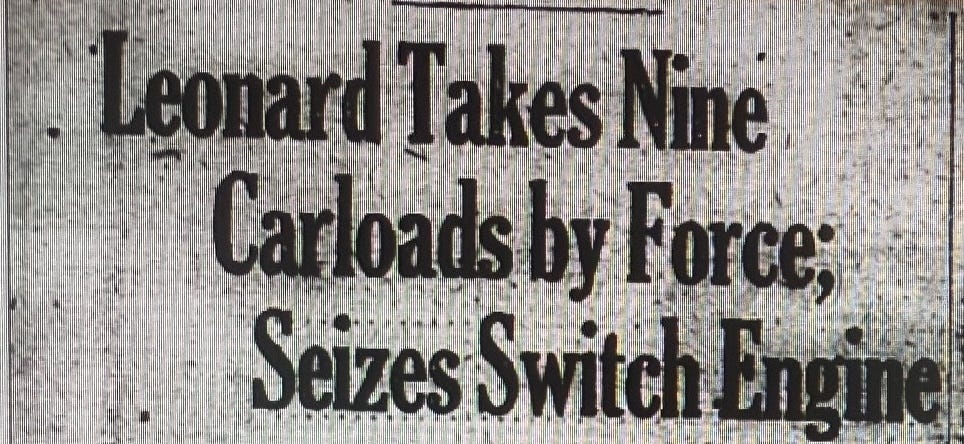
CITY OFFICIALS SEIZE
COAL IN LOCAL D. & H. YARD
SARATOGA SPRINGS, N.Y., February 19, 1923 — Officials of the City of Saratoga Springs took direct action today to provide coal for emergency cases, which they said could get relief by no other method.
Dr. Arthur J. Leonard, commissioner of public safety, heading a detachment of policemen and firemen, went to the Delaware & Hudson railroad yard about 11 o’clock this morning and seized, in the name of the city, nine cars loaded with anthracite coal.
Throwing a guard about them, he made efforts to have a Delaware & Hudson switch engine pull two of the cars to the Congress Street yard of the Saratoga Coal Company for distribution to emergency cases, but the crew refused. Dr. Leonard then officially seized a switch engine, placed on it a crew of police employees who were former railroad men, and had the cars taken to the Congress Street yards.
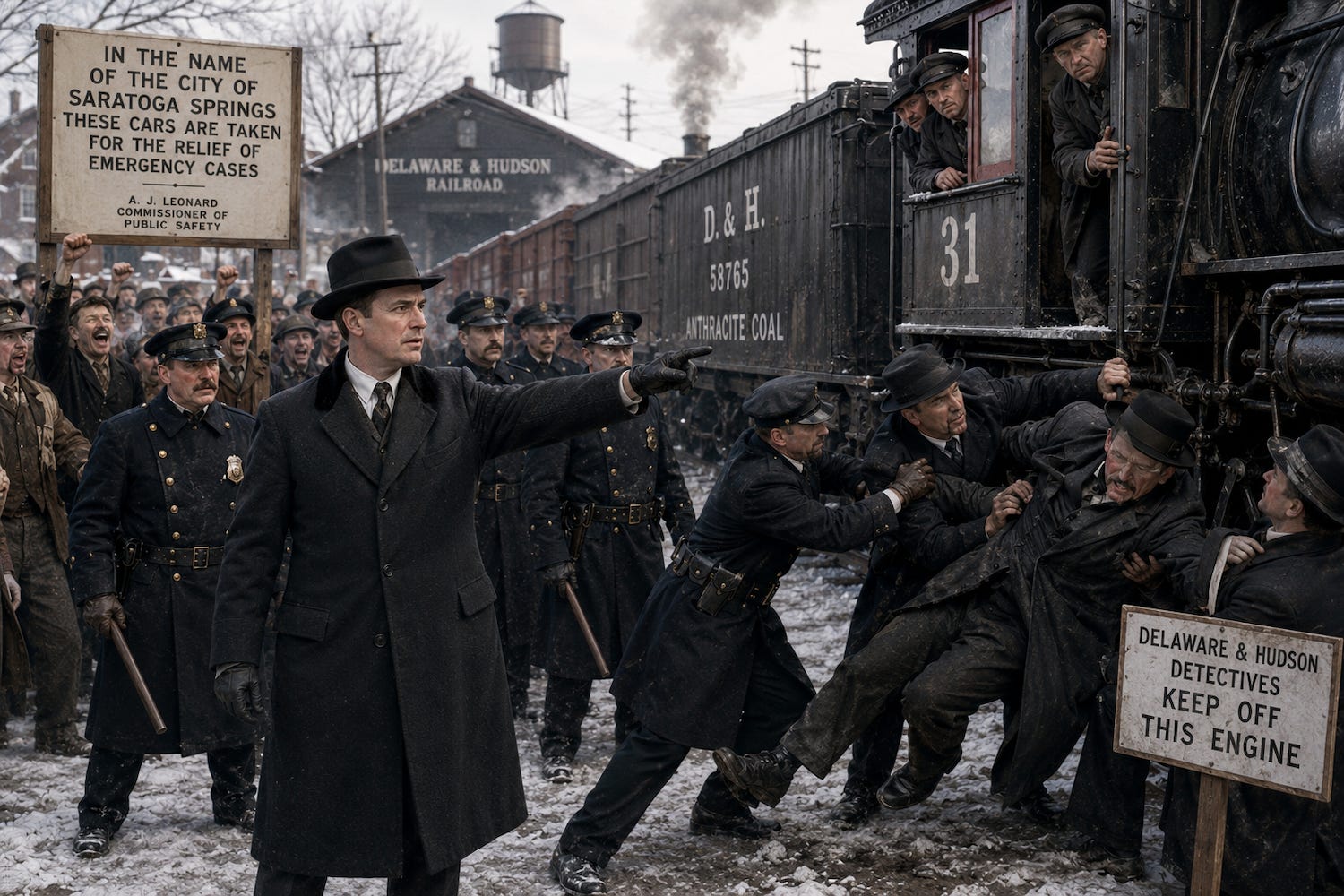
Meanwhile, a force of Delaware & Hudson detectives, headed by Edward T. Carroll, former chief of police here, boarded the engine and ordered the crew off. The police resisted, threw the detectives off the train and arrested one of them while the crowd cheered. The work then proceeded.
Shortly after one o’clock one car had been dumped in the yards and volunteer shovelers were unloading the other. When the Saratoga Coal Company refused to cooperate, Dr. Leonard notified Edward B. Ashton, president of the company, that he would seize the Congress Street yards, which he did, taking possession of a number of bags into which the coal was poured. Before two o’clock the Fire Department truck was on its way about the city filling emergency orders.
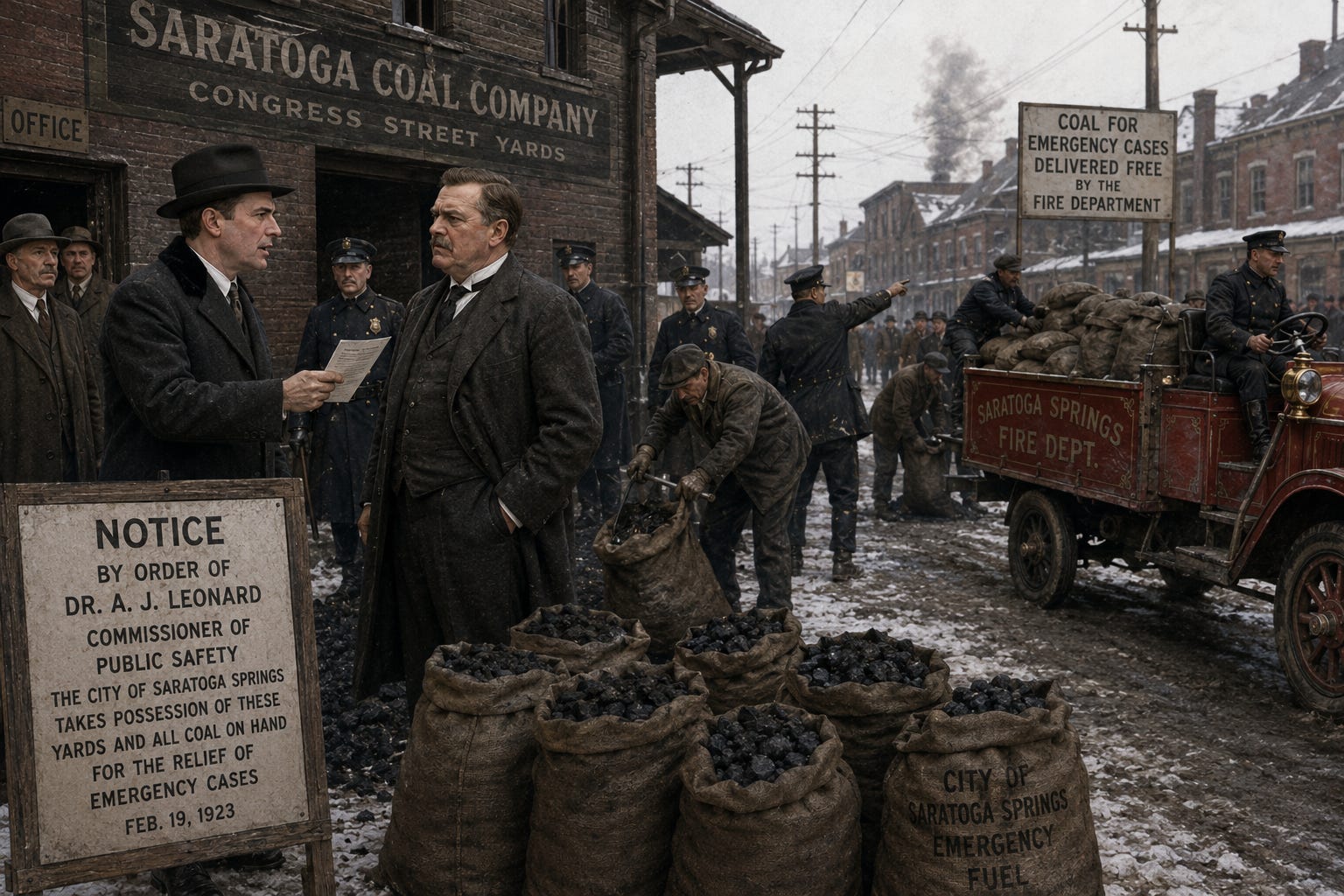
Dr. Leonard said he seized the coal under the health laws of the State, which, he declared, empowered him to take every measure necessary to avert sickness and death. He told The Saratogian that, at the time of the seizure, he had in his pocket approximately one hundred emergency orders received over Sunday from persons unable to secure coal.
He said the two carloads unloaded today would be sufficient for immediate needs, but that unless other relief arrived he would continue unloading additional cars from the railroad shipment. City police were assigned to guard the remaining cars throughout the night and were instructed to make arrests if any interference was attempted.
City Decides to Act
The plan under which the city officials worked today had been prepared Friday night but was not put into effect while they awaited action by Clarence H. Kilmer, Federal Fuel Administrator. City officials had urged him to release the coal for local emergency distribution. When no relief came, Mayor McNulty, Commissioner Leonard, and Commissioner Sherman agreed that the city itself must act.
Leonard immediately ordered all available policemen to report for duty. Fire Chief Shadick was instructed to place equipment and men at the city’s disposal. Leonard personally took command of the operation.
At the railroad yard he informed Delaware & Hudson officials that the cars, though still in transit, would be taken into the possession of the City of Saratoga Springs under authority of the public health laws. A cordon of police was thrown around the shipment.
Detectives Resist
Edward T. Carroll, formerly chief of police and now head of the Delaware & Hudson detective force, arrived with railroad detectives and attempted to remove the city crew from the seized switch engine.
Leonard warned that any interference would result in arrests. When detectives boarded the engine, city police forcibly removed them. During the struggle Henry Hickman, a railroad detective, was arrested on a charge of interfering with a police officer and ordered to appear in Police Court the following morning.
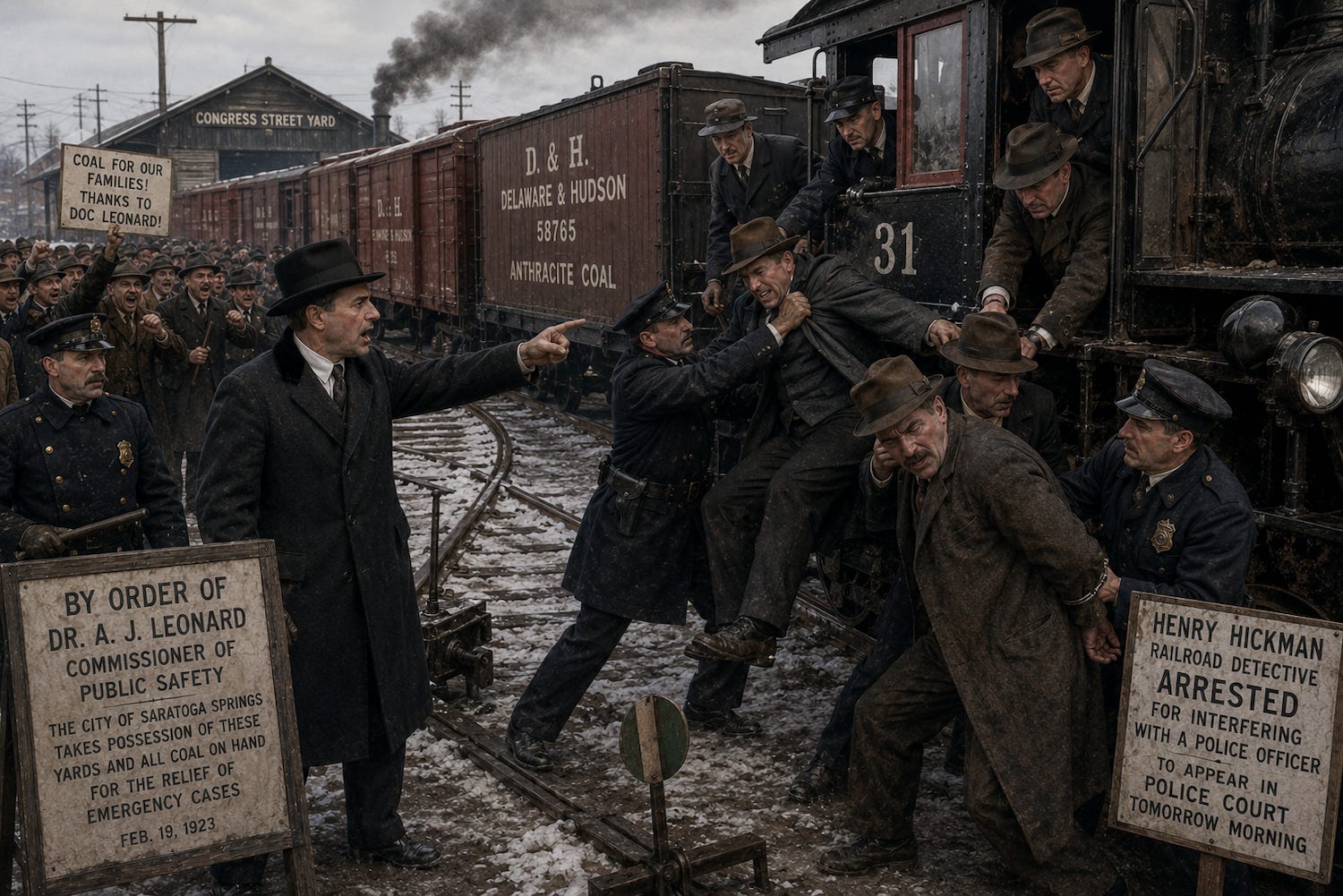
The volunteer crew then switched two cars from the main line onto the Congress Street siding without further interference.
Ashton Refuses Cooperation
Leonard telephoned Edward B. Ashton, president of the Saratoga Coal Company, requesting his cooperation in distributing coal to emergency cases.
Ashton refused and ordered company employees from the yard.
Leonard thereupon announced that he was taking possession of the Congress Street coal yards under the emergency powers he claimed under the State health laws.
Later Ashton began legal proceedings to eject the commissioner, serving papers upon Leonard, who accepted them without comment.
Volunteers Answer Call
News of the seizure spread rapidly throughout Saratoga Springs.
Citizens arrived with trucks, wagons, automobiles and baskets to obtain fuel. Leonard insisted that only genuine emergency cases would be supplied.
Volunteer shovelers worked continuously unloading the coal into bags while police supervised distribution.
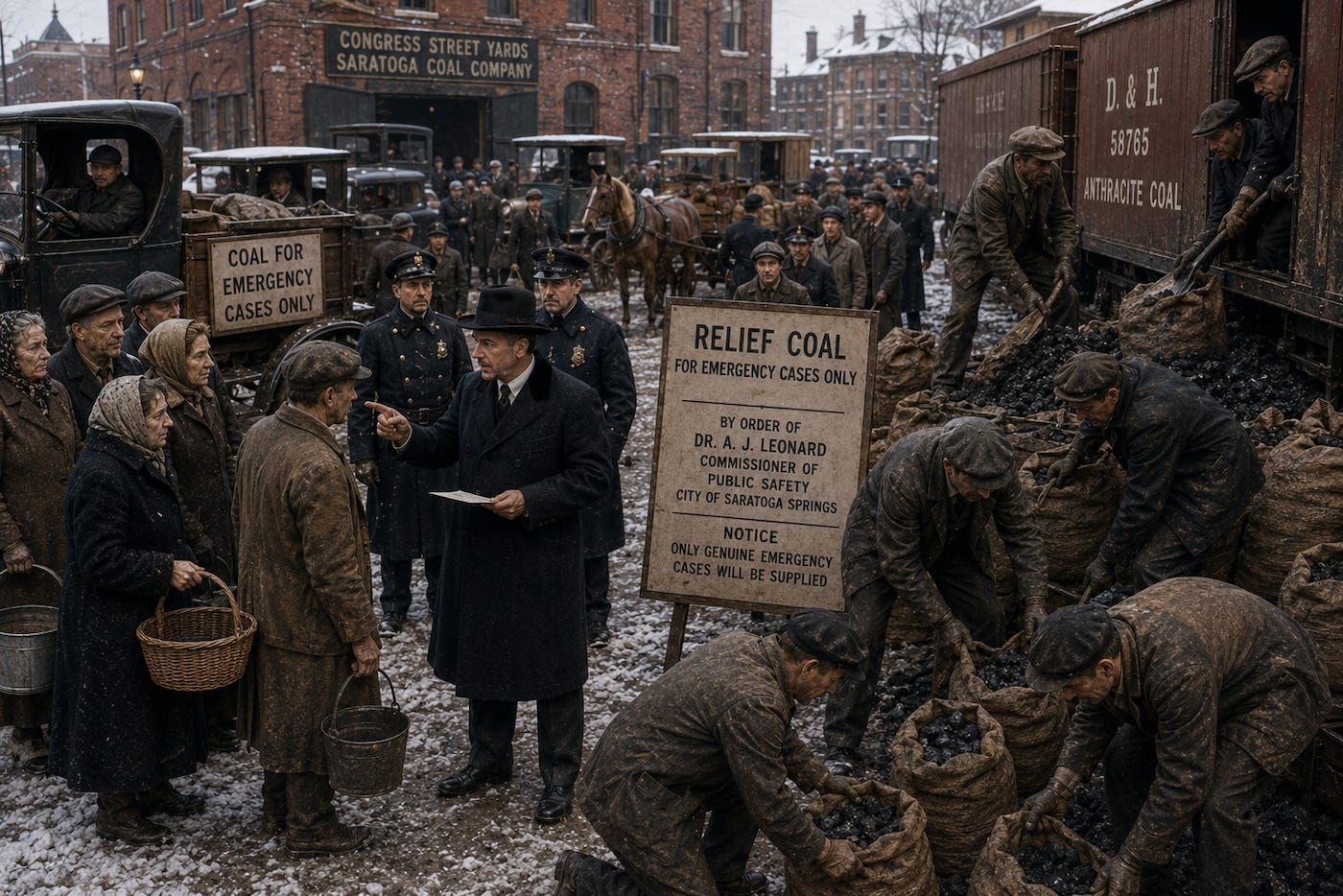
Among the first deliveries were coal for the Harvey Home, hospitals, schools, and families reported to be without fuel. Commissioner Leonard stated that numerous additional emergency requests continued arriving throughout the afternoon.
Officials anticipated legal action by both the Delaware & Hudson Railroad and the Saratoga Coal Company, but Leonard declared he would continue the distribution until every emergency need had been met.
The ‘Big Boss’ Takes Charge
Editor’s Note:
The February 1923 coal seizure explains why Doc Leonard became “the Big Boss.” It gave him enormous political capital. Thousands of Saratogans remembered him as the commissioner who ignored legal niceties to keep schools open, hospitals heated, and families from freezing during one of the worst fuel shortages the city had ever experienced. He had demonstrated decisive leadership when government at every other level appeared paralyzed.
Fast forward three years.
The emergency is over. Prohibition is in full swing. Saratoga’s “open city” policy has become firmly entrenched. Leonard has consolidated power, and his reputation extends far beyond his official title as Commissioner of Public Safety. The newspaper no longer treats him simply as a city official. It refers to him matter-of-factly as the “Big Boss.”
The June 29, 1926 story captures a different Leonard. Instead of leading police in a dramatic confrontation with the Delaware & Hudson Railroad, he is quietly strengthening his political machine. The questions posed by The Saratogian tell readers everything they need to know:
“Why is Public Safety Commissioner Leonard engaged in strengthening his fences so energetically?... Why is the ‘Big Boss’ leaving no stone unturned to bring everybody into his fold?”
The paper reports that Leonard is reaching out even to former enemies, mending political fences, and assembling a coalition so broad that seasoned observers conclude he must be preparing for a major political battle.
They are right. The battle is not with reformers. Not yet. It is with Jim Leary.
Ironically, the Republican who had worked alongside Leonard in preserving Saratoga’s open-city government appears to have become his political rival. The machine that had once appeared unified was beginning to fracture. Or was it?
Neither Leonard nor Leary knew that a greater threat was coming from another direction that would put them on the same side: The Saratoga Taxpayers Association, led by Peter Finley.